

What Happens If I Have a Bad Hair Transplant? Can I Still Fix It?
What Happens If I Have a Bad Hair Transplant? Can I Still Fix It?
First, a Bad Hair Transplant Does Not Always Mean It Cannot Be Repaired
If you are looking in the mirror and wondering, “What happens if I’ve had a bad hair transplant? Can I still fix it?” the answer in many cases is yes. But the options for a bad hair transplant repair procedure depend on a variety of factors including what went wrong, whether you are dealing with poor density, an unnatural hairline, scarring or misplaced grafts, and most importantly the condition of your remaining donor hair.
But there is an important qualifier: not every disappointing result can be completely reversed. What can realistically be corrected depends on what went wrong, how long it has been since your procedure, the condition of your scalp and existing hair, and how much healthy donor hair remains available.
That is why the next step after a disappointing hair transplant should not automatically be another transplant. It should be a careful, in-person evaluation of what happened and what actual options remain.
Rule #1: Before You Assume Your Hair Transplant Failed, Give It Enough Time
A hair transplant can look concerning before it looks better. Transplanted hairs commonly shed after surgery, and new growth develops gradually as the follicles move through their normal growth cycles.
If your procedure was recent, what appears to be poor density or failed growth may not represent the final result. Hair transplant outcomes are generally evaluated over many months rather than weeks.
If you are experiencing unusual pain, signs of infection, significant inflammation or another medical concern following surgery, however, contact the physician responsible for your procedure promptly. Those symptoms should not be treated as simply a cosmetic concern while you wait for hair growth.
If sufficient time has passed and the result still looks unnatural, sparse, scarred or noticeably different from what you expected, it may be time for an independent evaluation.
What Can Actually Go Wrong With a Hair Transplant?
A successful hair transplant involves much more than moving hair follicles from one part of the scalp to another. Hairline design, donor management, graft selection, placement, density, angle and direction all contribute to how natural the finished results look.
Problems that may arise include:
- An unnaturally low, straight or sharply defined hairline
- Large or obvious grafts along the frontal hairline
- Hair growing at unnatural angles or in the wrong direction
- Patchy or inadequate density
- Poor graft survival or growth
- Visible FUT linear scarring
- Diffuse FUE scarring or an overharvested donor area
- Too much donor hair used during an earlier procedure
- Poor planning for the progression of future hair loss
The International Society of Hair Restoration Surgery (ISHRS) has identified many of these same concerns in its guidance on revising previous hair transplants, including overly low or straight hairlines, incorrectly angled grafts, FUT scarring and FUE donor areas that have been overharvested.
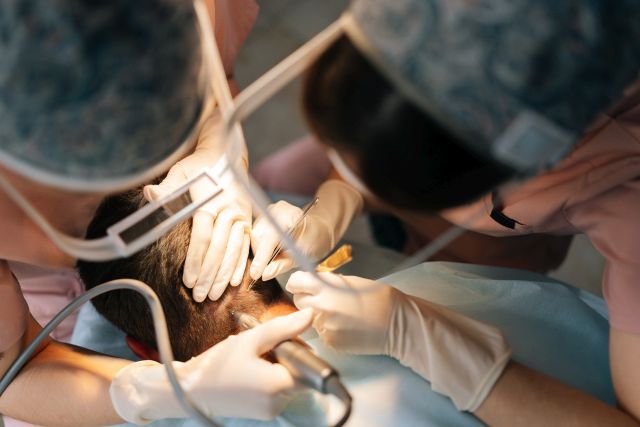
So, Can a Bad Hair Transplant Be Repaired?
Many bad hair transplant results can be improved, but the solution depends entirely on the problem.
Some patients need additional grafts to soften an unnatural hairline or improve density. Others may need strategically planned correction around poorly positioned existing grafts. Scar camouflage, scalp micropigmentation or a combination of surgical and non-surgical techniques may be appropriate in other cases.
This is where the distinction between having another hair transplant and correcting a previous hair transplant becomes important.
Bad hair transplant repair cases require the hair restoration team to work with decisions that have already been made: follicles that have already been harvested, existing scar tissue, previously transplanted grafts and potentially a donor area with fewer resources remaining.
For a closer look at the corrective options Van Scoy provides, visit our Hair Transplant Repair & Corrective Hair Restoration page.
The Most Important Question May Be: How Much Donor Hair Do You Have Left?
One of the most important factors in any bad hair transplant repair procedure is the condition of the donor area.
Hair transplantation redistributes follicles from areas of the scalp that are generally more resistant to pattern hair loss. Those follicles are a limited resource. Once they have been removed, they cannot simply be replaced with an unlimited new supply.
The ISHRS specifically notes that the donor region represents a limited supply and that excessive harvesting can leave it thin or patchy. Proper donor management is therefore an important part of both an initial transplant and any future corrective procedure.
This changes the conversation considerably.
Instead of simply asking, “How many more grafts can we put in?” an experienced hair restoration team needs to consider:
- How much viable donor hair remains?
- Has the donor area already been overharvested?
- Where would additional grafts create the greatest visual improvement?
- How is the patient’s natural hair loss likely to progress?
- Will using more donor hair now limit options later?
Sometimes the best corrective plan involves another transplant. Sometimes it does not.
Can an Unnatural Hairline Be Corrected?
In many cases, an unnatural transplanted hairline can be improved.
A natural hairline is not simply a straight boundary between forehead and hair. Natural hairlines contain subtle irregularities and changes in density, while individual hairs emerge at carefully varying angles and directions.
If a previous transplant created an overly straight, low, dense or “pluggy” appearance, strategically placed follicular units may sometimes be used to soften the transition and create a more natural appearance.
The American Academy of Dermatology notes that advances in hairline creation and the placement of small numbers of healthy hairs at a time have made natural-looking hair transplant results possible. Those same aesthetic principles become especially important when correcting an unnatural result.
More complicated hairline problems may require a staged approach. An in-person examination is necessary to determine what is realistically achievable.
What If My Hair Transplant Looks Thin or Patchy?
Thin or patchy results do not always have the same cause.
The original procedure may not have transplanted enough viable follicles to create the desired coverage. Some grafts may not have survived. Native hair surrounding the transplanted area may also have continued to thin after the procedure.
These situations can look similar in the mirror but may call for very different solutions.
If sufficient donor hair remains, additional transplantation may improve coverage in selected areas. If progressive hair loss is contributing to the appearance, the broader pattern of hair loss also needs to be considered before committing additional donor follicles.
The goal is not simply to add hair. It is to understand why the area looks thin and whether additional surgery makes sense over the long term.
Can an Overharvested FUE Donor Area Be Fixed?
This can be considerably more challenging.
During an FUE hair transplant, individual follicular units are extracted from the donor area. If too many follicles are removed, particularly from a concentrated area, the back or sides of the scalp may develop a visibly thin, uneven or “moth-eaten” appearance.
Severe overharvesting can also reduce the number of follicles available for future corrective procedures.
Depending on the extent of the problem, possible approaches may include carefully planned corrective transplantation or scalp micropigmentation (SMP) to help reduce the visual contrast between hair and exposed scalp.
In severe cases, however, additional surgery may not be advisable. A responsible evaluation includes recognizing when further harvesting could create more problems than it solves.
What About Scarring From a Previous Hair Transplant?
Both FUT and FUE procedures can leave scars, although the type and pattern of scarring are different.
FUT typically produces a linear donor scar, while FUE creates many small extraction sites distributed throughout the donor area. How visible those scars become depends on surgical technique, healing characteristics, hair length, donor density and other individual factors.
Depending on the type and extent of scarring, carefully placed grafts may sometimes help camouflage a scar. Scalp micropigmentation may also be considered in appropriate cases to reduce the contrast between scar tissue, surrounding hair and scalp.
The realistic goal may not always be to make a scar disappear completely. It may be to make it substantially less noticeable.
Bad Hair Transplants Do Not Only Happen Overseas
Low-cost international hair transplant clinics have received considerable attention in recent years, particularly as more patients travel abroad for surgery. But geography alone does not determine the quality of a hair transplant.
A poor transplant can occur overseas or in the United States. What matters is the medical oversight, experience of the professionals involved, surgical planning, donor management, technique, patient selection and follow-up care.
The ISHRS has raised concerns about procedures performed by improperly trained or unlicensed individuals, citing potential outcomes that include visible scarring, poor growth, bald patches and depletion of the donor area.
If your procedure was performed outside the United States and you are now trying to determine what to do, we have also prepared a separate guide: Returned From Overseas With a Bad Hair Transplant? Here Is What to Do Next.
Wherever your original procedure was performed, the basic principle is the same: understand what happened before deciding what to do next.
Be Careful About Trying to “Fix” a Bad Transplant Too Quickly
Being unhappy with a transplant understandably creates urgency. You have already invested time, money and considerable trust in the first procedure, and you may simply want the problem corrected as soon as possible.
But corrective hair restoration is precisely where caution matters most.
The ISHRS warns that poorly planned corrective surgery can create additional scarring and further damage donor and recipient areas. In some situations, insufficient donor hair or unrealistic expectations may mean another surgical procedure should not be performed at all.
That is an important point for anyone considering revision surgery: the best second opinion is not necessarily the one that promises another procedure.
It is the one that gives you a realistic understanding of what can and cannot be improved.
What Should a Hair Transplant Repair Evaluation Include?
A proper corrective evaluation should consider your entire hair restoration history rather than focusing only on the area that bothers you most.
That may include evaluating:
- Your original hair loss pattern and how it has progressed
- The type and number of previous transplant procedures
- Hairline design and existing graft placement
- The angle and direction of transplanted hair
- Recipient-area density and graft survival
- Donor-area density and remaining follicular resources
- FUE or FUT scarring
- Signs of donor overharvesting
- The condition of your existing native hair
- Your expectations for corrective treatment
Only after those factors are understood should the discussion move to specific treatment options.
Why Experience Matters Even More the Second Time Around
Correcting a previous transplant can be more complicated than starting with an untouched scalp. The available donor supply may already be reduced, scar tissue may be present, existing grafts must be incorporated into the new plan, and future hair loss still needs to be considered.
Van Scoy Hair Clinics has worked with men and women experiencing hair loss for more than five decades. Today, that experience includes access to surgical and non-surgical hair restoration options, allowing corrective cases to be evaluated from a broader perspective rather than assuming another transplant is always the answer.
When surgical correction is appropriate, the objective is to develop a plan around the patient’s existing hair, scalp condition, remaining donor supply and long-term pattern of hair loss. When surgery is not the best option, alternatives can also be considered.
What Should I Do If I Think My Hair Transplant Is Bad?
If you are unhappy with a previous hair transplant, start by determining whether enough time has passed to fairly evaluate the result. If you are experiencing a medical complication, contact the physician responsible for your care promptly.
If the transplant has matured and you remain concerned about an unnatural hairline, poor density, scarring, incorrect growth direction or donor-area damage, seek an experienced second opinion before committing to another procedure.
Bring any information you have about the original transplant, including the procedure date, technique used, estimated number of grafts and before-and-after photographs. The more your hair restoration team understands about the first procedure, the better they can evaluate what may be possible now.
Most importantly, do not assume that because the first result disappointed you, the only solution is to add more grafts.
The right corrective plan begins with understanding what you have to work with.
Can Van Scoy Help Fix a Hair Transplant Performed Somewhere Else?
Yes. Van Scoy Hair Clinics evaluates men and women who are dissatisfied with hair transplant procedures performed by other providers, whether those procedures were performed in Ohio, elsewhere in the United States or overseas.
The first step is an in-person assessment of your existing transplant, donor area, scalp and current pattern of hair loss. From there, the team can explain which corrective options may be appropriate and, equally important, the limitations that need to be considered.
Learn more about hair transplant repair and corrective hair restoration at Van Scoy, including the evaluation process and potential approaches to revision.
Frequently Asked Questions About Bad Hair Transplants
Can a bad hair transplant be fixed?
Many poor hair transplant results can be improved. The options depend on what went wrong, the condition of the recipient and donor areas, existing scarring, continued hair loss and how much usable donor hair remains. Some cases can be improved surgically, while others may benefit from non-surgical approaches or a combination of techniques.
Can you redo a failed hair transplant?
Sometimes. Another transplant may be possible if sufficient healthy donor hair remains and additional surgery can realistically improve the result. A corrective procedure should only be planned after evaluating why the original transplant produced an unsatisfactory outcome.
How long should I wait before deciding my hair transplant is bad?
Hair transplant growth develops gradually over many months, so early shedding or low density does not necessarily indicate failure. Follow the postoperative timeline provided by your physician. If you have medical concerns such as unusual pain, infection or significant inflammation, contact your physician promptly rather than waiting for the cosmetic result to mature.
Can a bad hairline from a hair transplant be fixed?
In many cases, an unnatural hairline can be improved by carefully redesigning the transition and strategically placing appropriate follicular units. The possibilities depend on the location and direction of existing grafts, available donor hair and the overall pattern of hair loss.
Can an overharvested donor area grow back?
Follicles that have been permanently removed during FUE do not regenerate in the donor area. Some temporary postoperative shedding may recover, but true overharvesting can leave lasting thinning or scarring. Corrective options depend on the severity of the damage and remaining donor resources.
Can scalp micropigmentation help a bad hair transplant?
In selected cases, yes. SMP may help reduce the appearance of certain scars or create the visual impression of greater density where additional transplantation is limited or undesirable. It does not grow new hair, and its suitability should be evaluated individually.
Can a hair transplant from Turkey or another country be repaired in the United States?
Yes. Corrective treatment does not necessarily have to be performed by the clinic that completed the original procedure. An experienced U.S. provider can evaluate the transplant, donor area and remaining hair to determine whether corrective treatment is appropriate.
What if I do not have enough donor hair for another transplant?
Additional surgery may not be advisable when donor resources are severely depleted. Depending on the individual situation, options such as scalp micropigmentation or non-surgical hair replacement may provide alternative ways to improve the cosmetic appearance without further depleting the donor area.
Before You Commit to Another Procedure, Understand Your Options
A disappointing hair transplant can be difficult, but it does not automatically mean you are out of options. The important question is not simply whether another procedure can be performed. It is what can realistically be improved while protecting the hair and donor resources you still have.
Van Scoy Hair Clinics provides private consultations for hair transplant repair and corrective hair restoration at our Ohio locations. We can evaluate your previous transplant, discuss what concerns you about the result and help you understand the options that may still be available.
Explore Hair Transplant Repair & Corrective Hair Restoration at Van Scoy
Sources & Medical References
Van Scoy Hair Clinics is committed to providing clear, responsible information about hair restoration procedures and corrective options. The following independent medical and professional resources were consulted in preparing this article:
- International Society of Hair Restoration Surgery (ISHRS): Revision and Repair of Previous Hair Transplants
Guidance on unnatural hairlines, poorly positioned grafts, donor-area overharvesting, scarring and options for corrective hair restoration. - International Society of Hair Restoration Surgery (ISHRS): Maximizing the Donor Area in Hair Transplant Surgery
Professional guidance on donor-area assessment, preservation and the importance of managing the limited supply of transplantable donor hair. - American Academy of Dermatology: Hair Transplantation
Patient guidance covering hair transplant expectations, normal postoperative shedding, growth timelines and natural-looking results. - Mayo Clinic: Hair Loss Diagnosis and Treatment
Medical overview of hair loss treatment and hair restoration surgery, including how transplantation redistributes a patient’s existing hair.
Get Answers From Ohio’s Hair Restoration Experts
Every type of hair loss is different, which is why every recommendation should be personalized. Schedule your free, private consultation with an experienced Van Scoy Hair Clinics specialist to get honest answers, explore your options, and discover the solution that best fits your goals.